Payment allocation and schedules
The payment schedule shows what is expected. Allocations show how received money was used. Compare both when explaining a balance or correcting a payment.
- For
- Loan-servicing and reconciliation users explaining a schedule, payment distribution, or balance.
- Requires
- Access to the loan, payment schedule, payments, and allocation detail.
- Available when
- The loan has a calculated schedule or recorded payment distribution to inspect.
- Before you begin
- Confirm the calculation date, payment number, amount, action, allocation order, and any additional invoice lines.
- Expected result
- You can account for the payment amount across allocation outcomes and explain the resulting schedule and balance.
Instalment, payment, and allocation
| Item | What it represents | Check it when |
|---|---|---|
| Instalment | An expected amount and due date in the loan schedule. | You need to explain what was due and whether it is issued, overdue, paid, or cancelled. |
| Payment | Money received, including payer, amount, date, type, action, and allocation order. | You need to match Finsaku to a receipt or provider transaction. |
| Allocation | The calculated treatment of part of that payment. | You need to explain which scheduled or additional amount was settled, or why money is pending, held, or in overpayment. |
The allocation order is an input to payment calculation. Allocations are the result. See the Glossary for the short definition and related terms.
Payment distribution outcomes
One payment can produce more than one outcome. The date, action, allocation order, due amounts, and product rules determine how each part is classified.
Read the schedule
Each instalment has a due date, amounts such as principal and interest, and a status.
| Instalment status | Meaning |
|---|---|
| New | Expected but not yet issued or due under the configured process. |
| Issued | Active scheduled amount. |
| Overdue | Due date passed with an amount still unpaid. |
| Paid | Required amount was fully settled. |
| Cancelled | Instalment was cancelled by an applicable process. |
The first or final instalment can differ from the others because of day counts, payment-date rules, commission, or rounding.
Read payment distribution
Distribution can be grouped by allocation status, payer, or payment type. Allocation statuses mean:
| Status | Meaning |
|---|---|
| Allocated | Applied to a specific schedule or invoice amount. |
| Pending | Recorded but awaiting the point at which it can be allocated. |
| Deposit | Held for later general allocation. |
| Penalty Deposit | Held for later penalty allocation. |
| Overpayment | More was received than the current calculation could apply. |
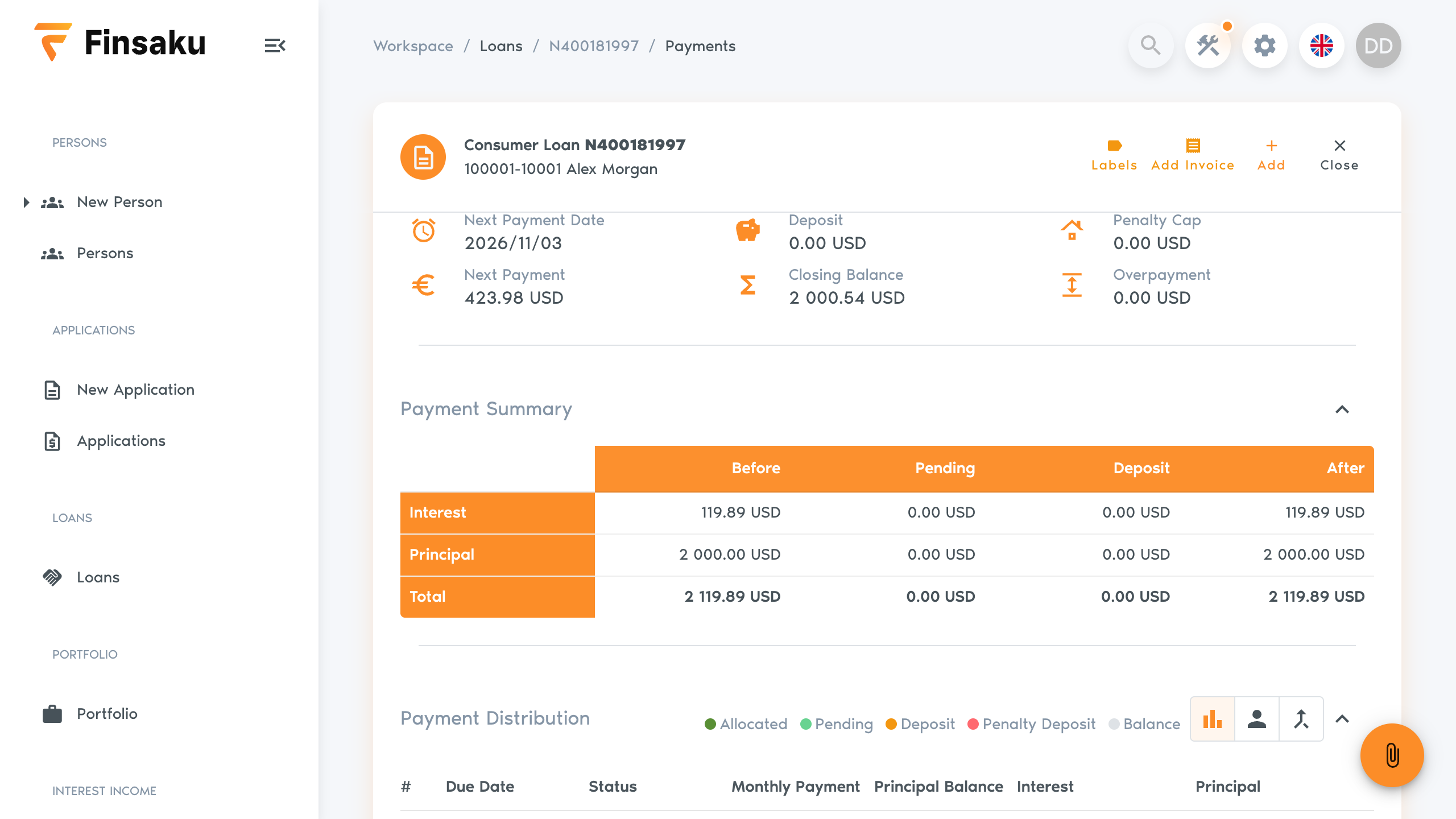
The payment preview separates Before, Pending, Deposit, and After values by line and in total. Use these columns to see which balance a payment changed.
Additional invoice lines
When permitted, a user can add product-related amounts outside the standard principal and interest schedule. Available types include permit preparation, commission, debt collection, vehicle repossession, reinstatement fee, and amendment fee. Enter the applicable amount and due or service dates, then verify its position in allocation.
An additional line is not automatically proof that the cost may be charged. Use it only under the applicable agreement and internal procedure. Deleting a line can recalculate allocations and requires confirmation.
Investigate an unexpected balance
- Check the calculation date in Actual Information.
- Compare the payment date with the instalment due dates.
- Open the payment distribution and note the selected action and allocation order.
- Check pending, deposit, penalty deposit, and overpayment amounts.
- Review added or deleted invoice lines and payments in history.
- If an integrated bank payment is involved, compare its provider transaction with the Finsaku payment record.
For a missing or apparently duplicated bank payment, follow the integrated bank-payment reconciliation before making a manual correction.