Service a loan and record a payment
This quickstart opens an active loan, records one incoming payment, and checks how Finsaku applied the money. Use the payment date, amount, and payer from the source transaction rather than estimating them from the schedule.
- For
- Loan-servicing users learning the payment and allocation path.
- Requires
- Loan read, payment calculation, payment creation, and payment list access for an eligible loan.
- Available when
- The loan exposes Payments and its status permits a new payment.
- Before you begin
- Start with one active loan, an unpaid scheduled amount, and an incoming payment that is not already present or awaiting a provider callback.
- Expected result
- One payment appears with the correct payer, amount, date, action, order, and distribution; the schedule and current figures reflect it.
| Quickstart point | This run |
|---|---|
| Estimated time | About 15 minutes, excluding receipt investigation or bank reconciliation. |
| Starting state | An active loan has at least one expected payment and the incoming payment has not been recorded. |
| Finish state | One regular payment is saved and its complete distribution is accounted for. |
Selecting Add records a real payment and recalculates the loan. Confirm the transaction belongs to the loan before committing it.
Workflow
Find and check the loan
- Open Workspace → Loans.
- Find an active loan.
- Open its Payments workflow.
Match real incoming payments using the source transaction information: payer details, payment reference or loan number, and any other identifiers required by your organisation. Do not continue when the transaction belongs to another loan, its currency differs, it may already be recorded, or a provider callback is still expected.
See Loan overview for the loan sections and status checks.
Record the receipt
- Select Payments on the loan.
- Under Payment, choose Regular payment as the Payment Type.
- Select or confirm the Payer.
- Review the Payment Order supplied by the product.
- Enter the receipt Amount and Payment Date.
- Choose Per payment schedule as the Payment Action for this scheduled incoming payment.
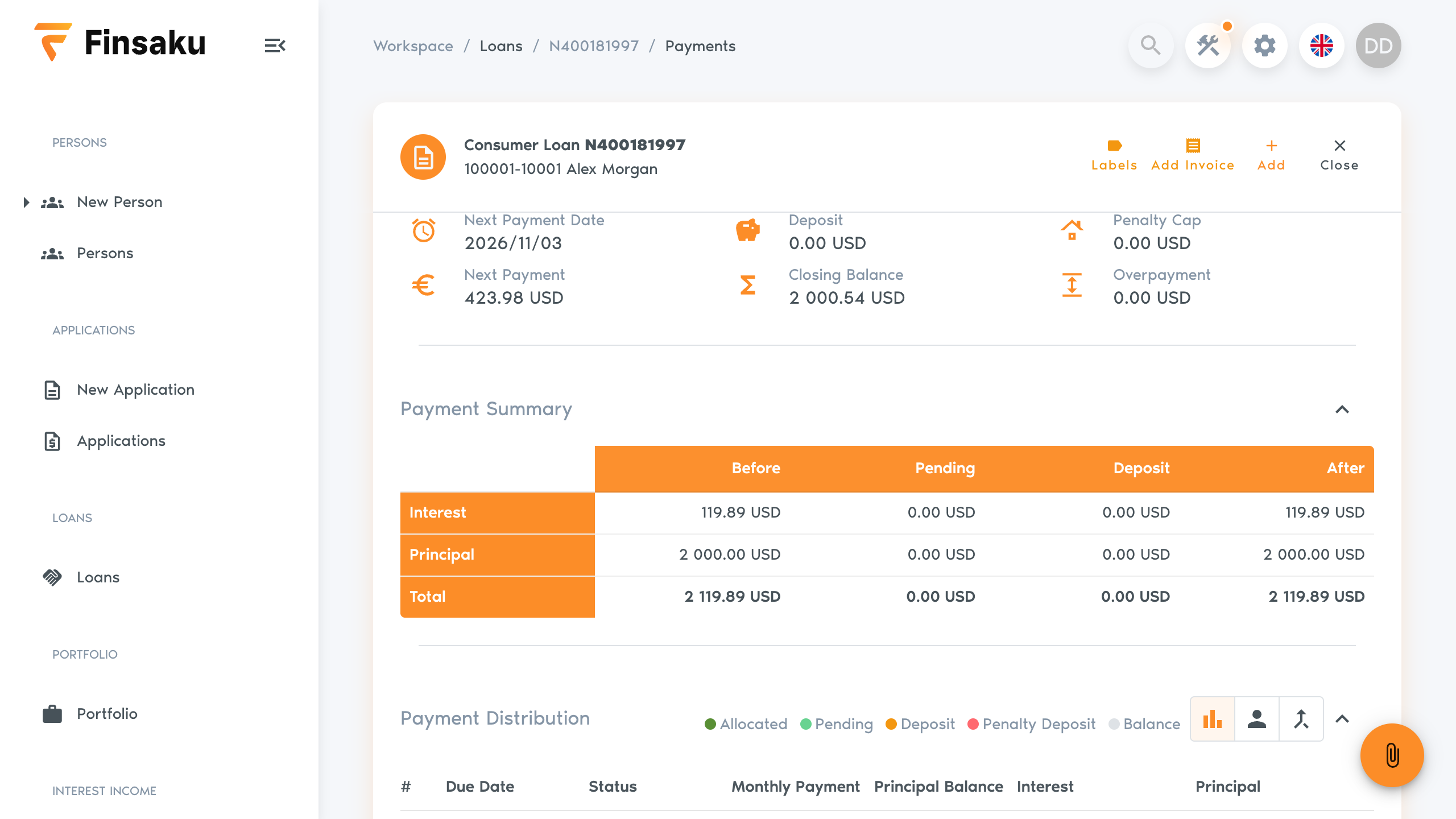
- Wait for the preview to update. Review the before, pending, deposit, and after figures and the payment distribution.
- Select Add once.
The payment date cannot be in the future or before the permitted last-payment boundary. Use Full repayment only for an authorised closing payment; it follows a different calculation from a scheduled incoming payment.
After Add, the payment should appear once in the payment list with the selected payer, amount, date, type, action, and payment order. If the result is uncertain, use the payment list and history before entering anything again.
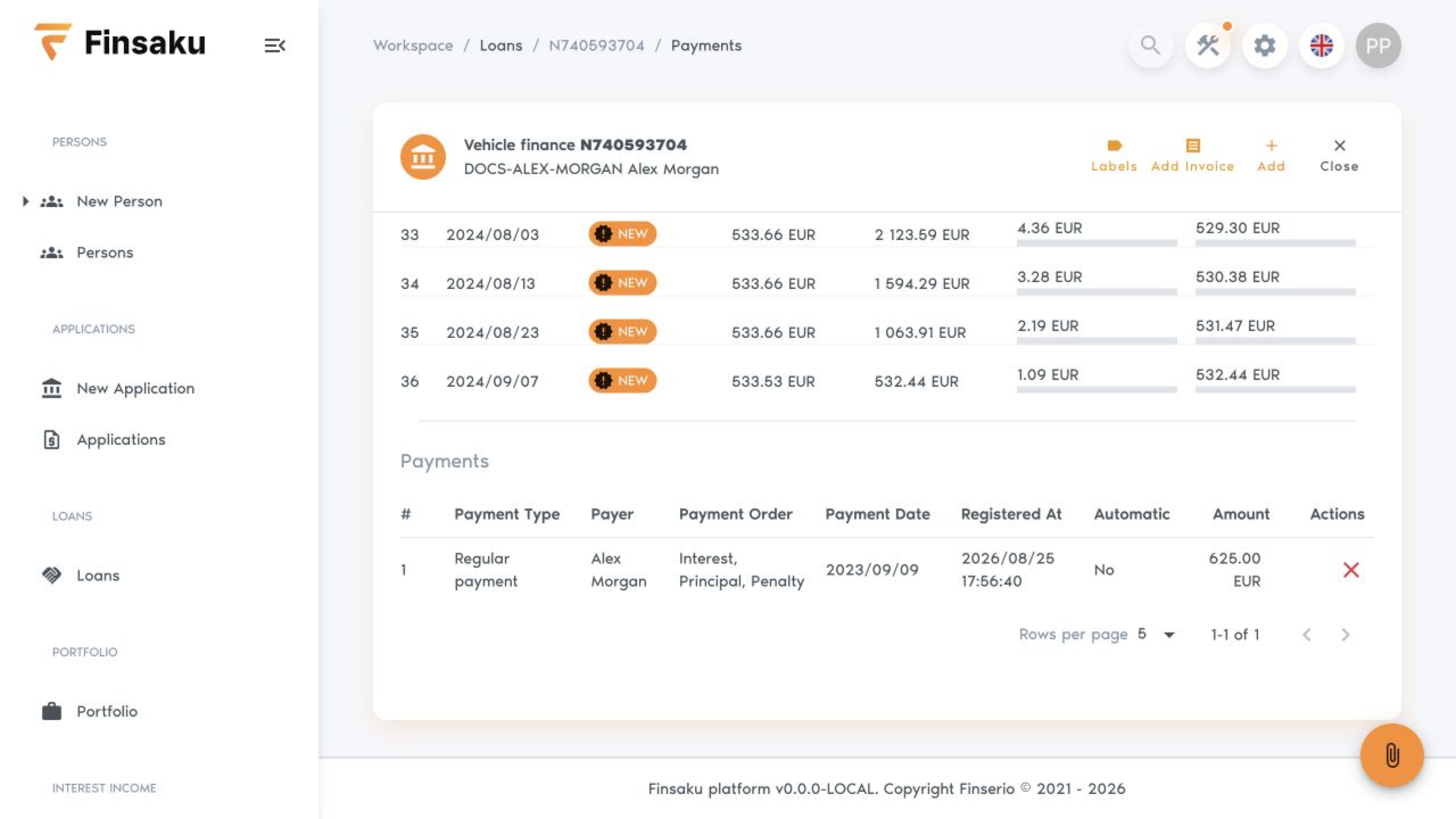
Allocation and schedules explains each distribution outcome and the checks for an unexpected balance.
Troubleshooting
| What you see | Check |
|---|---|
| Payments is absent | Loan status, payment permissions, and whether the loan has a full payment schedule. |
| The preview differs from the receipt or expected due amount | Payment date, action, payment order, additional invoice lines, and calculation date. |
| The payment is pending, deposited, or overpaid | Due dates and product allocation rules before treating the result as an error. |
| A banklink payment is still being confirmed | Provider transaction state, loan payment list, and history. A callback can still create the payment. |
| The payment appears twice | Do not add another correction. Record both payment numbers and follow the organisation's payment-correction procedure. |
Use Record payments before manually replacing an integrated bank payment.