Configure access for a new user
This quickstart shows how to create a new Finsaku user with the appropriate access level.
The scenario separates application entry from lending. Maya Collins is a customer-service representative who can create, update, and submit applications but cannot approve or lend them. Daniel Reed is a loan officer who can approve an application and use Lend to create the loan and contract.
- For
- Access administrators creating operational users and role groups.
- Requires
- User, permission-group, saved-query, and impersonation administration permissions.
- Available when
- The tenant uses password-based users and has a Workspace loan-application entry point.
- Before you begin
- Identify the lending product, application saved query, affiliation requirements, and separation-of-duties boundary.
- Expected result
- Each synthetic user can complete their assigned part of the application workflow and cannot cross the configured boundary.
| Quickstart point | This run |
|---|---|
| Estimated time | 30–45 minutes. |
| Starting state | No matching operational groups or synthetic users exist. |
| Finish state | Two active groups and users are in place, and their effective access has been observed with impersonation or direct sign-in. |
Workflow
Create the two permission groups
Open Administration → Add Group for each role. Enter the Name, add the starting permissions below, and select Add.
| Group | Task-level permissions | Do not add |
|---|---|---|
| Customer service representative | Find Persons, Find All Persons, Read Person, Init Quote, Save Quote, Read Quote, Find Quote, Generate Payment Schedule, Submit Quote, and List Internal Queries | Approve Quote, Reject Quote, Lend Quote |
| Loan officer | The customer-service set plus Approve Quote and Lend Quote | Broad payment, export, user-administration, group-administration, or impersonation permissions unless the job requires them |
The permission catalogue uses Quote for a loan application. These are task-focused starting sets, not a universal security policy. Use the task-based permission recipes for the detailed catalogue and optional document, note, message, assignment, label, and history permissions.
Permission names alone do not make the Workspace entry points visible:
- Open the internal saved query used to list applications and confirm its Location, visibility, and required permission.
- Ensure both groups have that query's required permission as well as List Internal Queries.
- Confirm the selected product is active and available from New Application.
- If an affiliation restricts visibility, configure and check that scope separately.
Create Maya Collins and Daniel Reed
Open Administration → Add User and create the following synthetic accounts. Use secure temporary passwords and do not include them in screenshots or documentation.
| User | Login | Group |
|---|---|---|
| Maya Collins | maya.collins@finsaku.com |
Customer service representative |
| Daniel Reed | daniel.reed@finsaku.com |
Loan officer |
For each account:
- enter the synthetic identity and unique Email;
- select an Affiliation only when the scenario requires partner-restricted access;
- select the one intended Group;
- enter User password and Confirm user password;
- select Add, then reopen the user and confirm Status, Groups, and User locale.
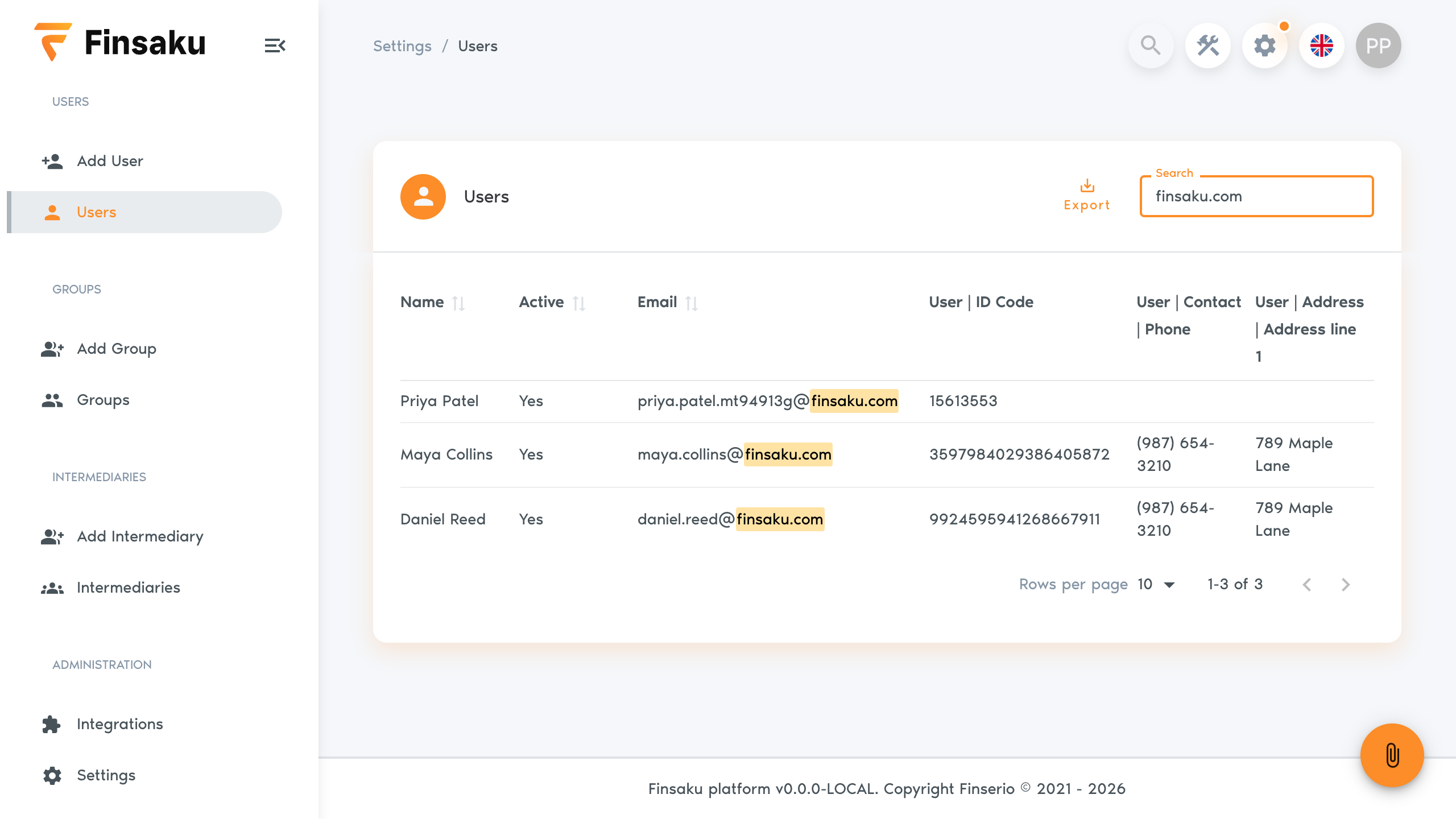
Use one account per individual. Users covers password rules, status, affiliation, and external identity-provider boundaries.
Observe Maya's application-entry boundary
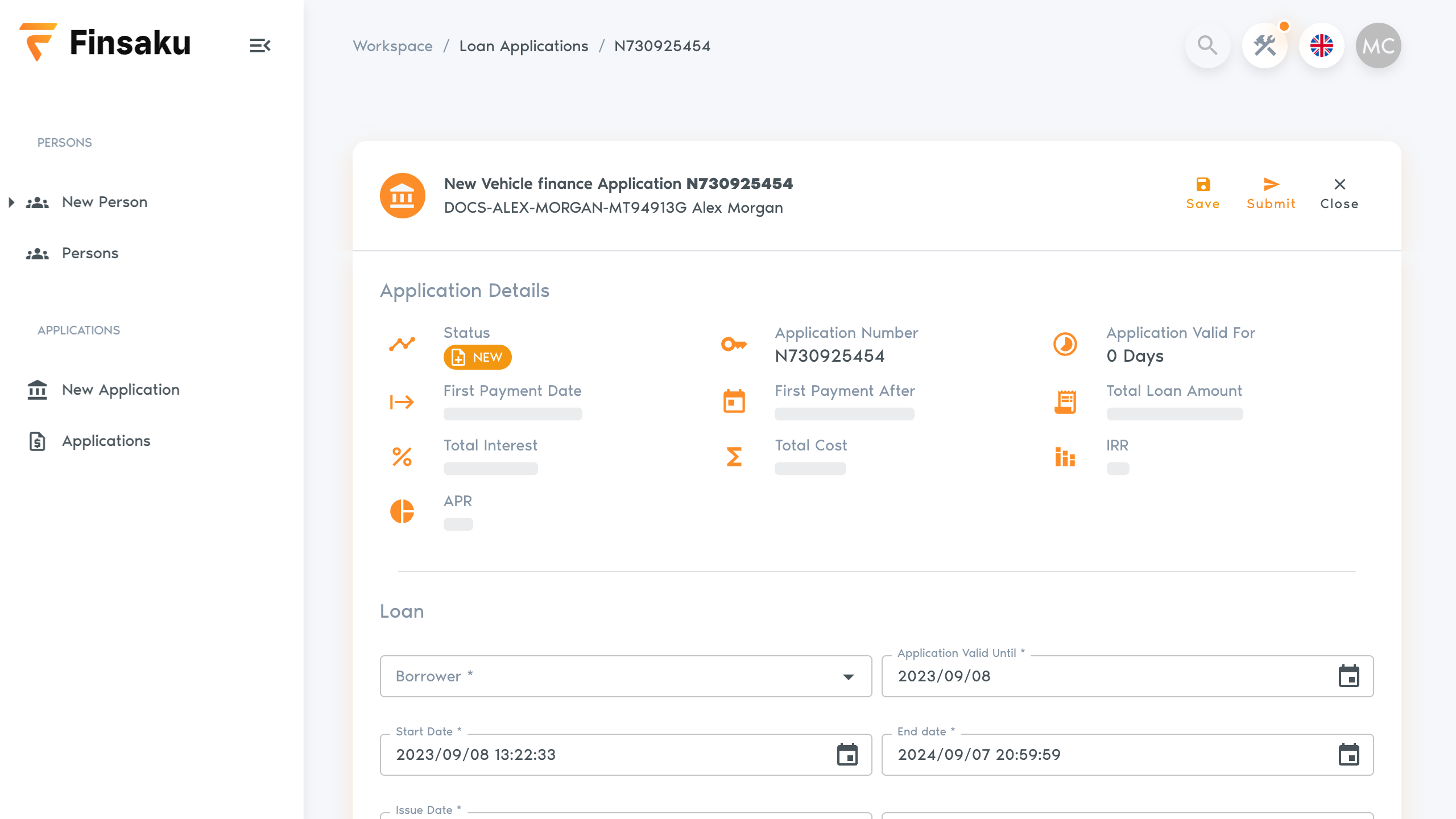
Open Maya Collins and select Impersonate.
- Open Workspace → New Application, select the configured product and borrower, enter valid requested terms, and wait for the schedule to update.
- Save or submit the application according to the configured workflow. Maya should be able to reopen and update it while that status permits editing.
- Open the resulting application and inspect its actions. Approve and Lend must not be available to Maya.
- Select Exit impersonation in the header to return to the administrator session.
Observe Daniel's approval and lending boundary
Open Daniel Reed and select Impersonate.
- Find Maya's application from the configured application list and open it.
- Review the application and use Approve when its status and configured workflow permit that action. Approval records the decision; it does not create a loan.
- Use Lend only after the application is approved and ready for lending. Lend changes the application to Issued and creates the loan and contract.
- Open the linked loan and confirm it is Active, then select Exit impersonation.
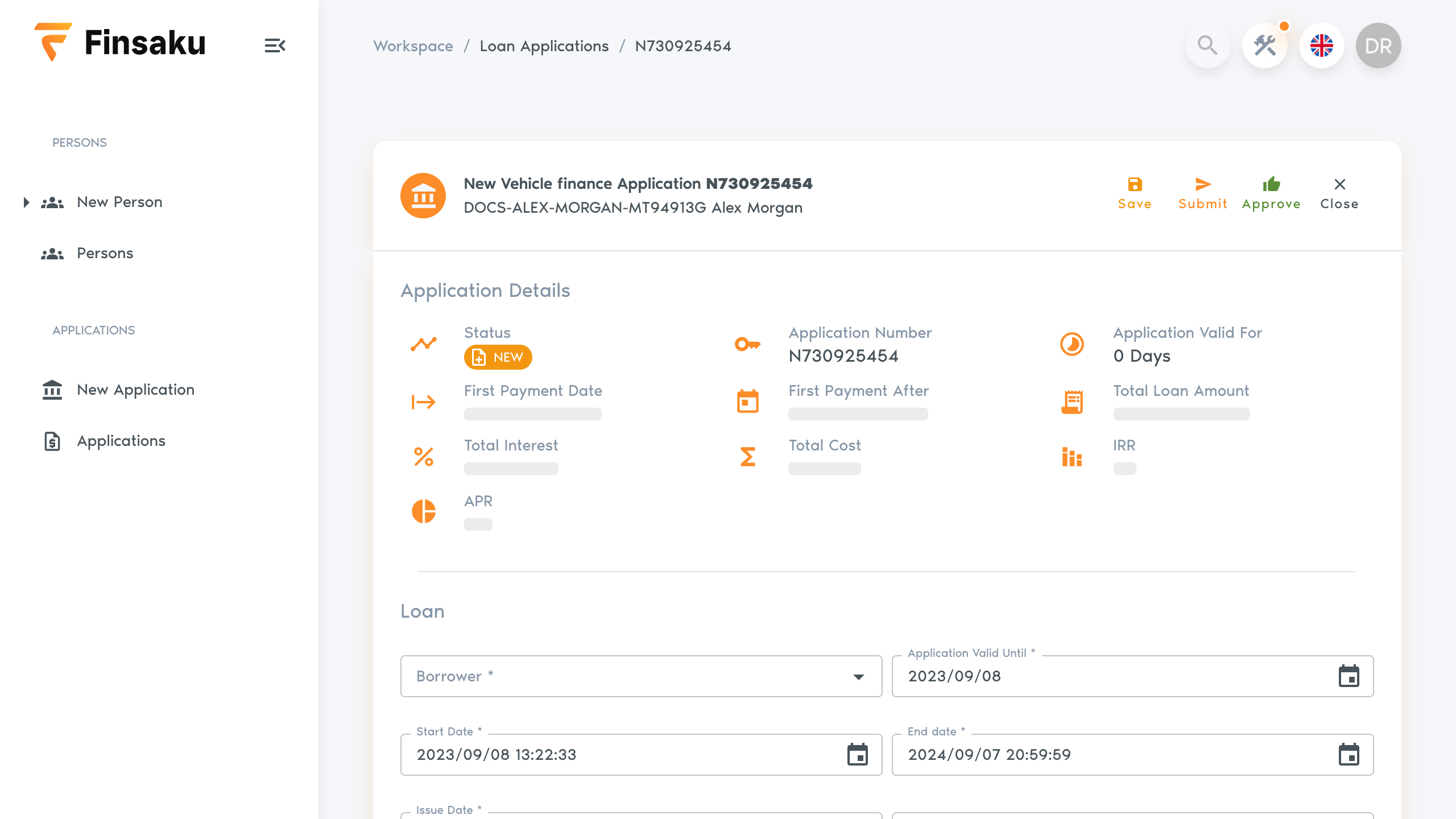
The positive and negative observations above establish effective access. A saved permission group by itself does not.
Troubleshooting
| What you see | Check |
|---|---|
| A user cannot find the application list | The saved query's location, visibility, required permission, and the user's List Internal Queries permission. |
| The application is absent from a visible list | Saved-query conditions, product, status, affiliation, and partner scope. |
| An expected action is absent | Exact Quote operation permission, application status, required data, and configured decisions. |
| Authentication error appears during impersonation | Return to the original Finsaku tab or use the browser's Back action. If the administrator header is available, select Exit impersonation; otherwise open the normal Finsaku sign-in page and sign in again as the administrator before continuing. Do not assume impersonation succeeded. |
| Impersonation remains unreliable | Exit or re-establish the administrator session, then use a separate browser session to sign in directly as the synthetic user. Sign out before switching identities and do not share credentials between users. |
| A user can do too much | Every active direct group and intermediary-supplied group, not only the group created here. |
Use Access model and troubleshooting to trace user status, group status, permissions, saved queries, and affiliation scope in order.