Product settings
A product contains the lending identity, calculator, invoice behaviour, collected data, templates, and automation for an offer.
- For
- Product administrators configuring a lending offer.
- Requires
- Product administration permission, a parent group, and any calculator, template, or integration dependencies.
- Available when
- The tenant supports the Lending product type.
- Before you begin
- Agree the product code, displayed name, currencies, calculator, invoice treatment, collected data, and allowed operations.
- Expected result
- The product is selectable in the intended menu and produces the tested fields, calculation, content, and actions.
Basic settings
| Setting | Purpose |
|---|---|
| Parent group | Places the product in the configured product hierarchy. |
| Icon | Identifies the product in lists and selectors. |
| Product name | User-facing name; translations can be maintained where enabled. |
| Product code | Stable identifier used by configuration and integrations. |
| Product type | Select Lending for a Finsaku lending product. |
| Calculator | Selects the standard calculation method or an enabled external calculator. |
Keep the product code stable after use begins. Before changing a calculator, assess existing applications and loans and test equivalent terms, dates, rounding, commission, and schedule totals.
The parent group controls where the product appears in the Administration tree and in the product choices used to start an application. Create and maintain that hierarchy under Product groups.
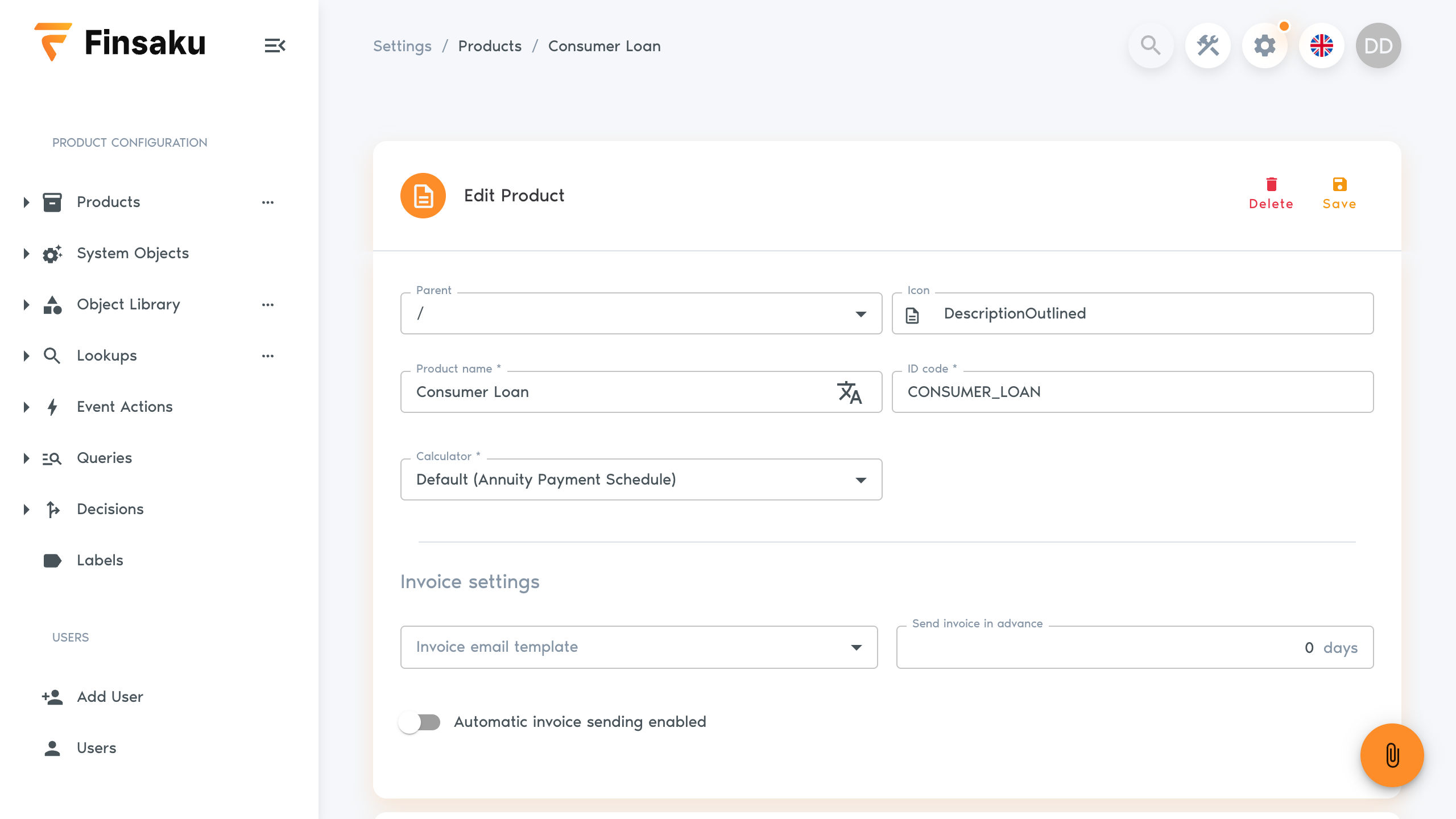
Calculator options
| Option | Result pattern |
|---|---|
| Annuity | Generally level principal-and-interest payments with a changing split. |
| Amortised | Generally level principal with declining total payments. |
| Enabled Loan Calculator integration | Calculation returned by the selected external service. |
External calculator names appear only when an enabled integration is configured. Disabling it can prevent affected products from calculating new work.
Invoice settings
Invoice settings select the email template, the number of days before the due date to send it, and whether sending is automatic.
Automatic sending requires an enabled email provider and a usable recipient address. Test the generated invoice, subject, dates, amounts, attachments, and resend behaviour before enabling it. Changing the lead time affects when future scheduled messages are selected; it does not prove that earlier invoices were sent.
Product content
A product can also contain:
- application and loan data objects;
- document templates;
- application and loan email templates;
- application and loan SMS templates;
- product-level event actions;
- versions, when the tenant enables product versioning.
Create dependent content only after the product identity, parent group, and code are agreed. Use Versions and data collection and Document and message templates for the detailed options.
Follow Set up a lending product to create the first catalogue group and product, then verify it from New Application.